
The Lore of Cottonwoods: The Trees That Listen, Heal, Collapse, and Come Back
Whenever I walk into a cottonwood grove, I lower my voice.
Not because I think I’ll get cursed.
Because I have the distinct feeling I’ve entered a room.
And rooms imply presence.
Presence implies witness.
And witness changes behavior.
Cottonwoods have carried that feeling for a very long time — across cultures, across rivers, across belief systems. And when you stack the ecology with the ethnography with the raw sensory experience?
The lore makes an uncomfortable amount of sense.
Let’s go all the way in.
The Biology That Started the Myth
Most of our Western cottonwoods are Plains cottonwood (Populus deltoides), Narrowleaf cottonwood (Populus angustifolia), and Black cottonwood (Populus trichocarpa).
They share one strange trait: flattened leaf stems (petioles). Instead of round, they’re compressed sideways — like nature installed a swivel joint.
That’s why cottonwood leaves tremble constantly. Even when the air feels still, they shimmer. They murmur. They produce a broadband rustling that your brain absolutely wants to interpret as whispers.
Add running water — where they almost always grow — and now you’ve got acoustics that blur into something conversational.
Your brain fills in the gaps.
That’s not mysticism. That’s auditory pareidolia.
But when enough generations experience the same sensory phenomenon?
Story grows.
The Lakota: The Axis Between Worlds
Among the Lakota people, cottonwood holds ceremonial weight. The central pole of the Sun Dance was traditionally cut from cottonwood — representing the axis between earth and sky.
Lakota holy man Black Elk, whose visions were recorded by John G. Neihardt in Black Elk Speaks, described sacred trees that bridge realms — living conduits between human and spirit worlds.
The trembling leaves were sometimes understood as spirit movement.
Not poetic metaphor.
Movement.
When your sacred ceremony centers around a tree, you pay attention to its behavior.
The Star Inside the Twig
Here’s one people miss.
If you slice a young cottonwood twig crosswise, you’ll see a five-pointed star in the pith.

That star carried cosmological meaning among several Plains tribes, including the Lakota and the Pawnee people, who tied their spiritual systems to star knowledge.
Later, Christian settlers noticed cross-like fissures in mature bark and layered their own symbolism on top.
Different cosmologies.
Same tree.
Everyone looking at geometry and saying, “Sacred.”
That overlap alone is worth sitting with.
River Messengers: Arapaho, Cheyenne, and Water
The Arapaho people and Cheyenne people lived in intimate relationship with river systems — and cottonwoods grow exactly where rivers pulse.
Ethnographic records from anthropologists like George Bird Grinnell note recurring symbolism tying cottonwoods to crossing points, ceremony sites, and spiritual presence.
In oral tradition, words spoken beneath cottonwoods could be carried downstream.
Now pause.
Cottonwoods grow where sound travels. Their leaves amplify subtle wind. Water conducts vibration.
Is it mystical?
Or is it ecological acoustics layered into narrative memory?
Honestly — both.
The Tree That Heals
Here’s where it gets herbal.
Cottonwood buds in early spring are sticky with resin rich in salicylates — natural anti-inflammatory compounds in the same biochemical family as aspirin.
The Blackfoot Confederacy and Crow people used cottonwood bud preparations for joint pain, muscle aches, skin irritations, and minor wounds — documented by ethnobotanist Clark Wissler.
So now we have:
A tree that whispers.
A tree that bridges realms.
A tree that heals inflammation.
It’s almost like the lore followed the pharmacology.
Beaver Engineers & Cottonwood Civilization
Beavers preferentially cut cottonwood.
Cottonwood regrows aggressively from disturbance.
Beaver dams expand wetlands, recharge groundwater, and create ideal conditions for cottonwood seedling establishment.
They co-create landscapes.
Remove beavers? Cottonwood regeneration declines.
Alter flood cycles with dams? Cottonwood groves age out and disappear.
Which means cottonwoods are ecological indicators. When they fade, something is wrong with the river system.
The “listening tree” goes quiet when the watershed is sick.
That’s myth and measurable data overlapping again.
Lewis & Clark: The Survival Tree
The Lewis and Clark Expedition journals repeatedly mention camping in cottonwood bottoms along the Missouri.
Cottonwoods meant:
-
Water
-
Firewood
-
Shade
-
Structural material
When explorers define geography by a tree, that tree is survival infrastructure.
Survival trees become story trees.
Always.
The Cotton Snow & The Flood
In spring, cottonwoods release drifts of seed fluff — what kids call “cotton snow.”
But those seeds only establish on freshly exposed, wet sediment left behind by receding floods.
No flood → no new grove.
They require disturbance to reproduce.
Flood → mud → seed → forest.
A tree dependent on chaos to survive?
That’s metaphorical gold.
Fast Life, Dramatic Death
Cottonwoods grow fast.
They hollow from the inside.
They split in storms.
They drop limbs without warning.
They are not stoic oak elders. They are dramatic river giants with messy endings.
That impermanence adds personality to lore. Movement + sound + collapse = character.
People anthropomorphize volatility.
The Acoustic Reality
The constant leaf tremble produces layered white noise that can:
-
Mask predator movement
-
Create shifting sound textures
-
Trigger your brain to interpret randomness as language
Your nervous system does not love ambiguity. So it invents pattern.
And in a cottonwood grove, the pattern feels like whispering.
Your biology collaborates with the environment to build myth.
Why the Lore Persists
Cottonwoods rarely stand alone. They form groves.
When you step into one:
-
Light shifts.
-
Air cools.
-
Sound changes.
-
Movement increases.
It feels architectural.
Architecture implies design.
Design implies intention.
Intention implies witness.
And humans behave differently when they feel witnessed.
So the saying likely grew from lived experience:
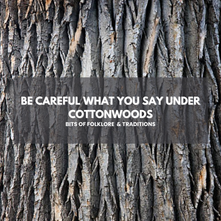
Be careful what you say under cottonwoods.
Not because they curse you.
Because they listen.
Because they heal.
Because they mark water.
Because they grow from flood.
Because they fall loudly.
Because they hold the star inside.
Next time you walk into a cottonwood grove — especially along a Montana river — pause.
Cut a twig. Look for the star.
Crush a bud. Smell the medicine.
Listen to the broadband whisper.
And maybe say something kind.
The river might be carrying it.