
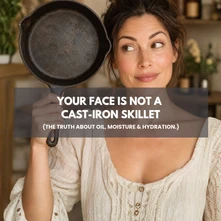
Your Face Is Not a Cast-Iron Skillet: The Truth About Oil, Moisture & Hydration
From the Apothecary | The Good Stuff Botanicals
There's a persistent skincare myth wandering around out there, and we think it's time someone escorted it politely to the door.
Oil and hydration are not the same thing.
Your face is not a cast-iron skillet. You can't simply grease it and call it hydrated.
Now, before every facial oil in the apothecary starts feeling personally attacked, let's make something clear: botanical oils are wonderful for your skin. They're rich in compounds that can help soften, condition, and support your skin's natural protective barrier.
They just don't do exactly the same job as water.
And here's where things get interesting: your skin needs both.
Your Skin Is a Living Barrier, Not a Greased Pan
Your skin is an impressive piece of biological engineering. Its outermost layer, the stratum corneum, is made up of flattened skin cells surrounded by a complex mixture of lipids.
Think of it like a brick wall. The skin cells are the bricks, and the lipids are the mortar holding everything together.
That mortar contains substances such as ceramides, cholesterol, and fatty acids. Together, they help protect against the outside world while preventing precious water from escaping too quickly.
When everything is working properly, your skin feels comfortable, flexible, and smooth.
When things get out of balance? Tightness, flaking, rough patches, and that delightful feeling that your face has suddenly shrunk two sizes.
The important distinction is that water and lipids have different jobs within this system.
Water helps keep the outer skin layers hydrated and flexible. Lipids help maintain the barrier that holds that water in.
Neither is particularly interested in doing the other's job.
Hydration vs. Moisturization: What's the Difference?
 |
 |
| Hydration Water and water-binding ingredients. |
Botanical lipids Softening, conditioning, and barrier support. |
These words get tossed around so interchangeably that it's no wonder people are confused.
Hydration refers to water content in the skin.
Moisturization is the broader process of improving skin softness, comfort, hydration, and moisture retention.
That means a moisturizing ingredient doesn't necessarily need to contain water.
And a product containing water doesn't necessarily provide lasting moisturization on its own.
This is where three important groups of ingredients come into play.
Humectants: The Water Wranglers
Humectants are substances that attract and bind water.
They help maintain hydration in the outer layers of the skin, where water is essential for normal flexibility and function.
Nature has some interesting contributions here.
Aloe vera, for example, contains polysaccharides and other water-soluble compounds that can contribute to a formulation's hydrating properties.
Certain naturally occurring sugars and plant-derived compounds also have water-binding abilities.
But here's an important detail: just because something comes from a plant doesn't automatically make it a humectant. Botanical waters, extracts, and oils each have their own chemistry.
And good formulation means understanding those differences.
Emollients: The Smooth Operators
This is where botanical oils really start showing off.
Emollients soften and smooth the skin, helping improve its texture and flexibility.
Plant oils can contain a fascinating collection of fatty acids, phytosterols, tocopherols, and other naturally occurring compounds.
Consider a few of our favorites:
-
Hemp seed oil: Rich in linoleic acid and alpha-linolenic acid, essential fatty acids that make it particularly interesting for skin conditioning.
-
Pumpkin seed oil: Supplies fatty acids, tocopherols, and other lipid-soluble plant compounds.
-
Rosehip oil: Valued for its unsaturated fatty-acid profile and skin-conditioning properties.
-
Meadowfoam seed oil: Known for its distinctive, oxidation-resistant fatty acids and smooth, protective feel.
And no, these oils aren't identical.
Their chemistry influences how they spread, absorb, feel, and interact with the skin's surface.
Botanical oils aren't simply grease in prettier bottles.
Some oils can also influence the skin barrier through their fatty-acid composition, although the effects depend on the oil, its quality, concentration, and the overall formulation.
That's a lot more interesting than calling them glorified sealants.
Occlusives: The Moisture Bodyguards
Your skin continuously loses water through a natural process called transepidermal water loss, or TEWL.
That's normal. Your skin isn't supposed to be completely waterproof.
But excessive water loss can contribute to dryness, tightness, and barrier discomfort.
Occlusive ingredients help reduce that evaporation by creating a protective layer on the skin's surface.
Botanical butters, waxes, and certain oils can contribute to this protective effect, though some are considerably more occlusive than others.
Shea butter and beeswax, for example, can help give a formulation richness and protective properties.
Here's the distinction worth remembering:
Hydrating ingredients help supply or bind water. Emollients soften and condition. Occlusives help reduce water loss.
And a beautifully formulated moisturizer can do more than one of those things at once.
Wait. Can Oily Skin Be Dehydrated?
Absolutely.
And this is where the whole subject gets especially interesting.
Your skin naturally produces sebum, an oily substance made by your sebaceous glands.
Sebum contains triglycerides, wax esters, squalene, and other lipids that contribute to the skin's surface environment.
But producing a lot of sebum doesn't guarantee that your skin has adequate water.
Oiliness describes how much sebum your skin produces.
Dehydration describes a shortage of water in the outer skin layers.
You can have a shiny forehead and still experience tightness, roughness, or dehydration.
Likewise, dry skin generally produces less sebum and may benefit from additional lipids and barrier support.
These conditions can overlap, but they're not interchangeable.
So before declaring war on your skin's natural oils, it might be worth asking what your skin actually needs.
After all, stripping your face into submission isn't a skincare strategy.
It's a disagreement with your own biology.
The Apothecary Approach: Water and Oil Aren't Enemies
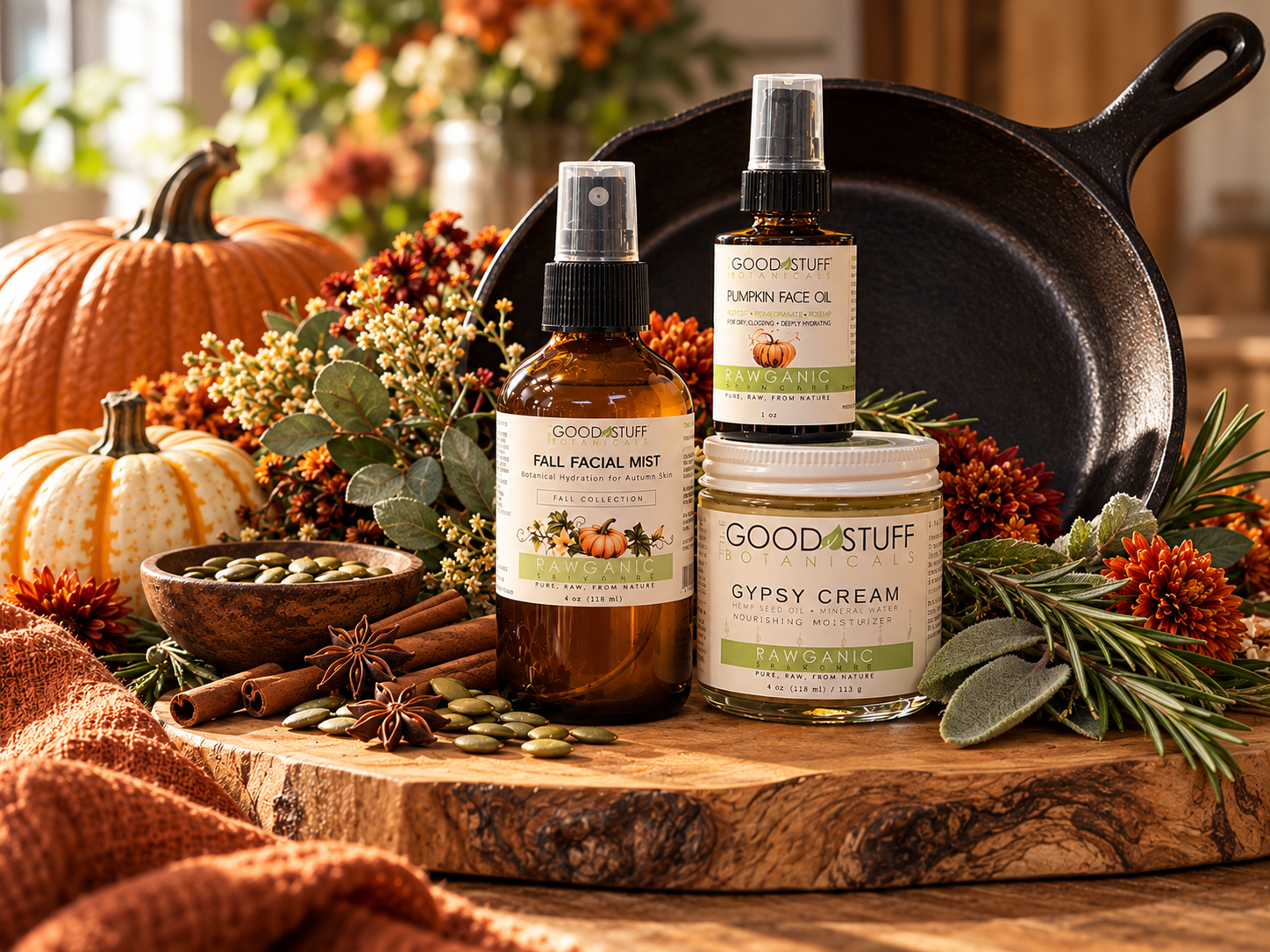
At The Good Stuff Botanicals, we make facial mists, facial oils, and moisturizers for a reason.
They're not competing for the same job.
They're different tools for supporting the same remarkable organ.
Take our Fall Facial Mist.
With aloe vera juice, witch hazel, coffee extract, and aromatic floral waters, it's a refreshing water-based botanical step. Aloe contributes water and naturally occurring plant compounds, while the other botanicals bring their own distinct properties.
A facial mist can temporarily wet and refresh the skin, providing a lovely foundation for the rest of your routine.
Now consider our Pumpkin Face Oil.
This formula brings together pumpkin seed, rosehip, pomegranate, hemp seed, argan, and meadowfoam oils.
That's an entirely different botanical toolkit, built around plant-derived lipids rather than water.
These oils help soften and condition skin while contributing to its protective surface.
One delivers a water-based botanical experience. The other provides concentrated lipid nourishment.
Neither needs to pretend to be the other.
And used together, they can make a lovely pairing, particularly when the air turns dry and cold.
And Then There's Gypsy Cream
Sometimes we don't want to choose between water and lipids.
We want both in one jar.
That's part of the thinking behind our Gypsy Cream Nourishing Moisturizer.
Made with organic hemp seed oil, Montana mineral water, raw shea butter, aloe vera, and beeswax, Gypsy Cream brings water-based and lipid-rich ingredients together in one formula.
The mineral water contributes the aqueous component. Hemp seed oil and shea butter provide emollient lipids. Beeswax contributes protective properties, while aloe adds its own botanical characteristics.
It's not about throwing every trendy ingredient into a jar and hoping for the best.
It's about understanding what different ingredients contribute and letting them work together.
Because thoughtful skincare isn't about choosing sides. It's about balance.
So, Should You Use a Mist, an Oil, or a Moisturizer?
That depends on your skin.
And we know. That's not nearly as satisfying as someone announcing one miracle ingredient that fixes absolutely everything.
But your skin isn't a standardized piece of equipment. It's living tissue influenced by genetics, age, environment, cleansing habits, hormones, and the weather.
Especially the weather.
Here in Montana, where winter air can turn the atmosphere into a giant dehydrator, skin often appreciates a little extra attention.
A simple approach might look something like this:
1. Cleanse gently.
Remove the day's dirt and buildup without stripping away everything your skin worked so hard to produce.
2. Refresh with a water-based mist.
A facial mist can temporarily hydrate the surface and help prepare the skin for what comes next.
3. Follow with your preferred moisturizer or facial oil.
Apply while the skin is still slightly damp to help maintain that comfortable, supple feeling.
You can also combine a moisturizer and facial oil when your skin wants additional richness.
And if your skin is already happy with a simple routine?
Wonderful. Keep doing what works.
Not everyone needs seven serums, three toners, and a twelve-step ritual performed under a waxing moon.
Although we do love a good moon.
The Botanical Takeaway

Here's what we'd really like you to remember.
Your skin isn't trying to be oil-free.
And it isn't trying to be waterlogged.
It's trying to maintain a healthy, functional barrier.
Water matters. Lipids matter. The balance between them matters.
Plant oils can contribute much more than a shiny finish, and water-based botanicals have their own important place in skincare.
The magic—if you'll forgive a little apothecary language—isn't that every ingredient does everything.
It's understanding what each ingredient brings to the formula.
Because good skincare works with your skin's natural chemistry instead of trying to outsmart it.
And as for that cast-iron skillet?
We love a beautifully seasoned pan as much as anyone.
But your face deserves a little more nuance than a coat of oil and a prayer.
Stay curious (and a little wild),
The Good Stuff Botanicals
Bigfork, Montana
Explore the Products: Fall Facial Mist · Pumpkin Face Oil · Gypsy Cream